

The Ottawa River holds the distinction of being Canada’s most regulated waterway. Its main channel and tributaries host over 50 major dams and 13 reservoirs. Many of these dams date back to the early 1900s, a period when environmental preservation was not yet a key consideration. Ottawa Name takes a closer look at the history and significance of these dams and reservoirs.
History of the Ottawa River Basin and Its Reservoirs
In earlier times, the Ottawa River served primarily as a trade route. European explorers and fur traders used the river to transport goods to the continent’s interior and between Montreal and Kingston. Later, it became a transportation path for timber to sawmills.
Some of the first reservoirs constructed on the Ottawa River include:
- Timiskaming, built in 1911
- Quinze, built in 1914
- Rapide 7, built in 1941
- Dozois, built in 1949
Initially, these reservoirs were created to assist navigation and mitigate the effects of floods. They also helped increase water flow during drought years. Over time, as urbanization accelerated, the reservoirs’ purpose shifted towards hydroelectricity production. Today, in addition to power generation, these reservoirs play a critical role in water storage, release, and providing various modern benefits.
Timiskaming Reservoir
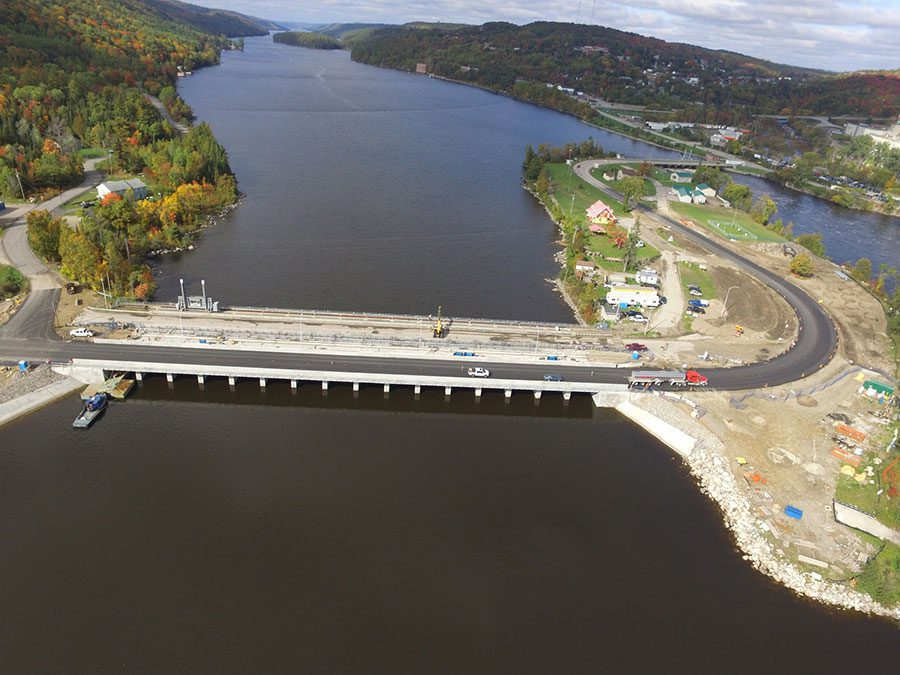
The Timiskaming dam complex is located about 65 kilometres northeast of North Bay, Ontario. Built in 1911, it consists of Ontario and Quebec dams. Notable facts about Timiskaming include:
- In the 1930s, the Quebec dam suffered structural damage, leading to its replacement. The Ontario dam underwent similar issues, resulting in reconstruction between 2014 and 2017.
- Timiskaming plays a crucial role in regulating the water levels of Lake Timiskaming and the Ottawa River.
Dozois Reservoir
Located within the Réservoir-Dozois and La Vérendrye Wildlife Reserve in central Quebec, Dozois Reservoir is a man-made lake formed in 1949 with the construction of the Bourque Dam. Its creation involved submerging smaller lakes, such as Dozois, Soulier, and parts of Déléage Bay.
History of Low-Head Dams on the Ottawa River
Due to low summer rainfall, low-head dams became common on the Ottawa River in the early 1900s. These dams typically span the river’s width, with seven such structures present along the main river.
For instance, the Metzger Road Low-Head Dam contributes to the Ferguson and Metzger reservoirs. Despite their historical success in managing water flow, low-head dams raise environmental concerns, such as:
- Obstructing fish migration along the river.
- Creating areas with reduced oxygen levels.
In October 2018, biology students from Ohio Northern University conducted a study on the river’s aquatic life to assess the biodiversity and the ecological impact of these dams.

Ottawa’s Generating Stations
Several generating stations along the Ottawa River play a significant role in the region’s energy production:
- Carillon Generating Station: Originally constructed in the 1870s-1880s and upgraded in 1964.
- Chaudière Dam: Built on a limestone ledge, the first structures were erected in the 1820s-1830s, with later additions in 1868 and subsequent hydroelectric development.
- Falls Generating Station: Established in 1931 upstream of the falls.
- Chenaux Generating Station: Began operations in 1951, featuring dams and a diversion channel.
- Bryson Generating Station: Operational since 1925 after construction commenced in 1923.
- Rapides-des-Joachims Generating Station: Built between 1946 and 1950 near the historic village of Des Joachims, Quebec, to regulate the water flow upstream to Mattawa.
Interesting Facts About the Ottawa River
- The river was explored and named in 1613 by Samuel de Champlain. It derives its name from the Algonquin people who inhabited the area.
- The river originates from Lake Capimitchigama in Quebec and flows into the Saint Lawrence River at the Chaudière Falls.
- Its deepest section measures 90 metres.
- The river freezes between mid and late December each year.
- Low water levels are attributed to factors like drought, minimal snowfall, and early spring thaws.
Although not a major transportation route today, the Ottawa River remains vital for hydroelectricity production. Several hydroelectric stations supply power to Ontario and Quebec. For example, the Chalk River Nuclear Station, established in 1944, focuses on research. The dams and reservoirs continue to contribute significantly to the region’s energy and water management.